


Page 15 - EM6-26_LOW
P. 15
INTERVIEW


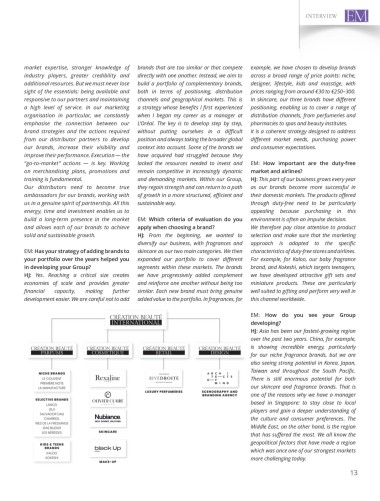
          market  expertise,  stronger  knowledge  of   brands that are too similar or that compete   example, we have chosen to develop brands
          industry players, greater credibility and   directly with one another. Instead, we aim to   across a broad range of price points: niche,
          additional resources. But we must never lose   build a portfolio of complementary brands,   designer, lifestyle, kids and masstige, with
          sight of the essentials: being available and   both  in  terms  of  positioning,  distribution   prices ranging from around €30 to €250–300.
          responsive to our partners and maintaining   channels and geographical markets. This is   In skincare, our three brands have different
          a  high  level  of  service.  In  our  marketing   a strategy whose benefits I first experienced   positioning, enabling us to cover a range of
          organisation in particular, we constantly   when I began my career as a manager at   distribution channels, from perfumeries and
          emphasise the connection between our   L’Oréal. The key is to develop step by step,   pharmacies to spas and beauty institutes.
          brand strategies and the actions required   without  putting  ourselves  in  a  difficult   It is a coherent strategy designed to address
          from our distributor partners to develop   position and always taking the broader global   different  market  needs,  purchasing  power
          our brands, increase their visibility and   context into account. Some of the brands we   and consumer expectations.
          improve their performance. Execution — the   have acquired had struggled because they
          “go-to-market”  actions  —  is  key.  Working   lacked the resources needed to invest and   EM:  How  important  are  the  duty-free
          on merchandising plans, promotions and   remain  competitive  in  increasingly  dynamic   market and airlines?
          training is fundamental.               and demanding markets. Within our Group,   HJ: This part of our business grows every year
          Our distributors need to become true   they regain strength and can return to a path   as our brands become more successful in
          ambassadors for our brands, working with   of growth in a more structured, efficient and   their domestic markets. The products offered
          us in a genuine spirit of partnership. All this   sustainable way.             through duty-free need to be particularly
          energy, time and investment enables us to                                      appealing  because  purchasing  in  this
          build a long-term presence in the market   EM: Which criteria of evaluation do you   environment is often an impulse decision.
          and allows each of our brands to achieve   apply when choosing a brand?        We therefore pay close attention to product
          solid and sustainable growth.          HJ:  From  the  beginning,  we  wanted  to   selection and make sure that the marketing
                                                 diversify  our  business,  with  fragrances  and   approach  is  adapted  to  the  specific
          EM: Has your strategy of adding brands to   skincare as our two main categories. We then   characteristics of duty-free stores and airlines.
          your portfolio over the years helped you   expanded  our  portfolio  to  cover  different   For example, for Kaloo, our baby fragrance
          in developing your Group?              segments  within  these  markets.  The  brands   brand, and Kokeshi, which targets teenagers,
          HJ:  Yes. Reaching a critical size creates   we  have  progressively  added  complement   we have developed attractive gift sets and
          economies  of  scale  and  provides  greater   and reinforce one another without being too   miniature products. These are particularly
          financial   capacity,   making   further   similar. Each new brand must bring genuine   well suited to gifting and perform very well in
          development easier. We are careful not to add   added value to the portfolio. In fragrances, for   this channel worldwide.

                                                                                         EM:  How do you see your Group
                                                                                         developing?
                                                                                         HJ: Asia has been our fastest-growing region
                                                                                         over the past two years. China, for example,
                                                                                         is showing incredible energy, particularly
                                                                                         for our niche fragrance brands, but we are
                                                                                         also seeing strong potential in Korea, Japan,
                                                                                         Taiwan  and  throughout  the  South  Pacific.
                                                                                         There is still enormous potential for both
                                                                                         our skincare and fragrance brands. That is
                                                                                         one of the reasons why we have a manager
                                                                                         based  in  Singapore:  to  stay  close  to  local
                                                                                         players and gain a deeper understanding of
                                                                                         the culture and consumer preferences. The
                                                                                         Middle East, on the other hand, is the region
                                                                                         that has suffered the most. We all know the
                                                                                         geopolitical factors that have made a region
                                                                                         which was once one of our strongest markets
                                                                                         more challenging today.

                                                                                                                            13

